
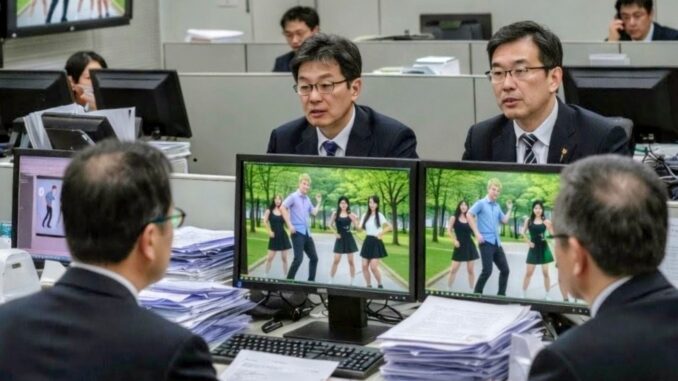
New Immigration Directive Requires ALTs to Perform Synchronized Dances With a “Pretty Japanese Girl” to Counter “Problematic Foreigner Clustering”
The policy is openly acknowledged internally as a strategy of forced attrition: by setting renewal requirements to “statistically unattainable” levels, the government expects ALT numbers to collapse naturally, leading to their complete phase-out by the end of 2026. The plan is to replace them with agentic AI systems, no visas, no unions, and no concerns about practices like desk-warming. A calculated, bureaucratic approach to smooth and respectful quiet elimination.
In what officials describe as a “necessary modernization of immigration screening,” the Takaichi Administration unveiled a sweeping new requirement for Assistant Language Teachers (ALTs) seeking visa renewals. Effective April 1, dispatch companies must now submit a TikTok dance video for each ALT as formal “Proof of Happiness & Social Integration” to the Immigration Bureau.
The directive, detailed in a 47-page policy document accompanied by a six-page appendix on acceptable background music and facial expressions, requires that each video visibly demonstrate the ALT’s “genki disposition” and “capacity for harmonious interpersonal bonding within Japanese society.”
The most contentious clause mandates that every performance include “a pretty Japanese girl” (可愛らしい日本人女性), dancing in visible synchronization with the ALT.
“This has nothing to do with entertainment,” said a Ministry of Justice spokesperson , speaking anonymously from behind an imposing stack of fax printouts. “It is about Wa. If a foreign instructor cannot convincingly coordinate a lighthearted dance with a local woman, it raises serious concerns about their ability to build confident, prolific relationships with hundreds of Japanese children…”
Dispatch companies nationwide have reportedly entered crisis mode. Internal sources at Heartless Link & Joy (formerly Joy-Talk Inter-Staff) described scenes of panic-buying involving ring lights, tripod stands, and “Beginner TikTok Choreography for the Socially Reserved.”
“Our ALTs are, statistically speaking, quiet English majors who spend their weekends translating obsolete manga or ranking ramen shops on Google Maps,” admitted Yuuta San, a field coordinator who requested anonymity. “Now we are expected to certify their social happiness through a public performance. Operationally, this is… challenging.”
The policy, personally championed by Minister Sanae Takaichi, is framed as a safeguard against what officials call “non-integrating foreign micro-communities.”
“We are observing an unhealthy pattern of ALTs who interact only with other foreigners or remain socially passive,” Minister Takaichi stated during a press conference restricted to government-approved outlets. “A TikTok dance, especially one featuring cheerful cross-gender interaction, is the clearest indicator of genuine social aptitude. The era of the ‘gaijin bubble’ is over.”
The document explicitly cautions against “forced smiles,” “emotionless execution,” and “excessive pelvic enthusiasm,” while stressing that the accompanying Japanese participant must appear “voluntary, relaxed, and sincerely entertained.”
Immigration officials confirmed that submissions will be reviewed by a newly formed Cultural Authenticity Committee, reportedly composed of retired karaoke bar owners, municipal event planners, and elementary school vice-principals selected for their “instinctive sense of genki.”
“If the joy is not immediately perceptible,” one official warned, “the application will be denied. There is no appeals process.”
At press time, several dispatch companies were said to be offering “integration incentives,” including a ¥1,300 bonus and one complimentary mugicha bottle, to any ALT who successfully secures a “pretty Japanese girl” and surpasses 1,000 views on their visa renewal TikTok.
Leave a Reply